Blog QR Code vs Barcode Wristbands: The Best Scanning System for Faster, Safer Event Entry
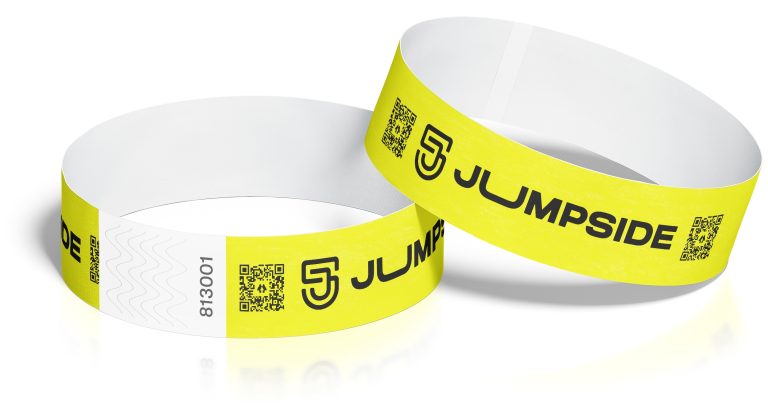
Scannable wristbands improve fast event entry by streamlining attendee verification, reducing queue times and supporting secure access control. QR codes offer flexible, high-capacity scanning, while traditional barcodes provide a simpler and more cost-effective option for straightforward entry requirements. Choosing the right credential technology protects the guest experience right from the front gates.
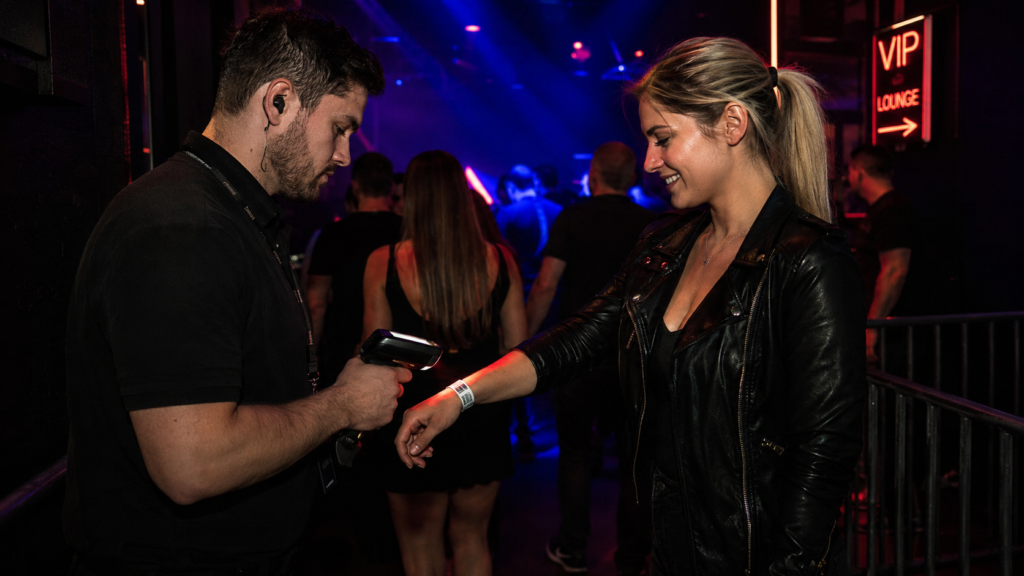
The main difference between the two systems is how they hold data. Traditional linear barcodes generally require clearer horizontal alignment with the scanner, while QR codes use a two-dimensional matrix that can be captured from a wider range of angles. Scanning from any direction is a practical advantage when you need to clear a sudden rush of thousands of attendees.
When entry technology processes attendees quickly, crowds remain in motion, helping maintain a positive atmosphere, prevent dangerous bottlenecks and allow security personnel to remain proactive rather than manage disorder in a packed queue.
When connected to an appropriate validation platform, both QR code and barcode wristbands can help organisers track arrivals, monitor access activity and identify duplicated, invalid or previously redeemed credentials at the point of entry. This gives venue managers a clearer view of attendance levels and movement through restricted areas.
The best choice depends on your specific venue layout and production budget. A massive outdoor music festival might need the high data capacity of a 2D matrix to handle complex VIP upgrades. A local community market can manage its entry gates using budget-friendly linear designs without sacrificing reliability.
| Feature | Barcode Wristbands | QR Code Wristbands |
|---|---|---|
| Data Capacity | Low (Ticket ID only) | High (Dietary, VIP Tiers, Schedules, etc.) |
| Scanning Angle | Horizontal alignment needed | Omnidirectional (any angle) |
| Hardware Needed | Basic laser scanners | Camer-enabled devices/tablets |
| Best Operational Fit | Simple admission validation with limited data requirements | Multi-zone access, attendee tracking and more complex integrations |
| Main Limitation | Requires clear presentation and may hold less data | May require camera-enabled devices and more complex software |
| Offline Capability | Depends on the validation platform | Depends on the validation platform |
| Setup Cost | Highly Budget-friendly | Moderate to High |
| Best For | School fetes, local sports | Music festivals, corporate conferences |
QR code wristbands support advanced event access by storing more attendee information, enabling flexible scanning and integrating with real-time event management systems. Their 2D structure can accommodate ticket details, access permissions, session information and other event-specific data within a single scannable credential. This turns a basic entry pass into a personalised tool for your guests, improving their journey through the venue.
This technology also shines when it comes to scanning flexibility. Standard smartphones and tablets can read the grid from any angle; your gate staff do not need to perfectly align the patron’s wrist. Removing this physical friction at the gate keeps your entry lanes moving at a rapid pace.
Real-time validation gives event teams an up-to-date view of venue capacity since each scan feeds into the central event management platform. Allowing organisers to identify when a VIP lounge or main-stage area is approaching capacity and redirect crowd flow before overcrowding occurs.
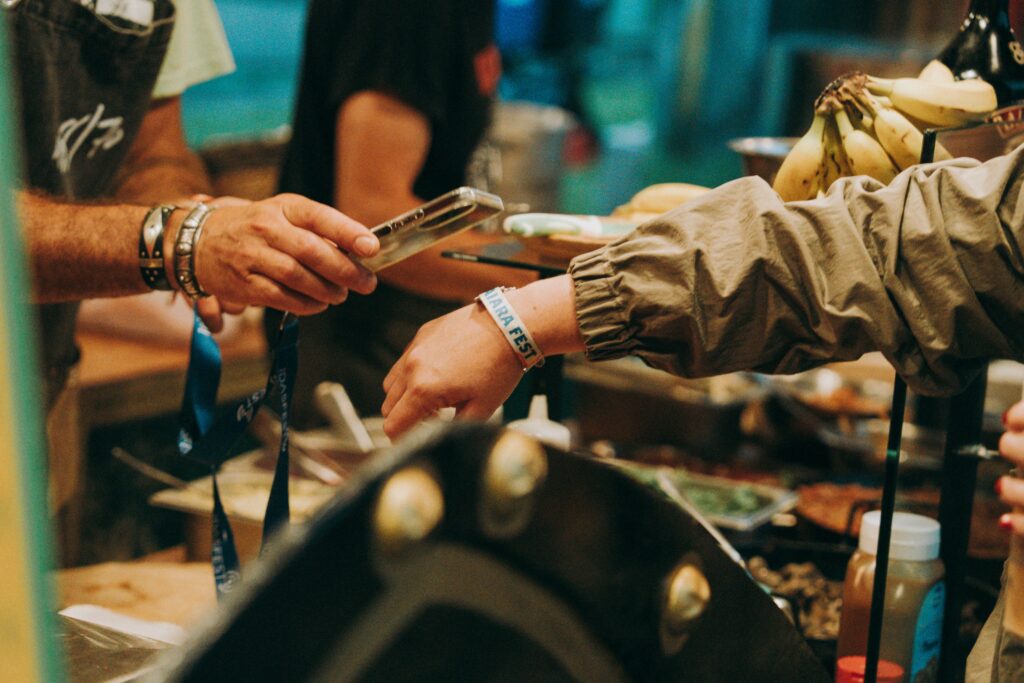
The integrations can extend beyond entry validation. Organisers may connect QR-coded credentials with cashless payment, merchandise or sponsor-activation systems, allowing patrons to scan their wristband at participating locations. Where contactless tapping is required, the wristband would generally need an RFID or NFC component in addition to the printed QR code.
For higher-security events, dynamic QR codes can strengthen the ticket-validation process before a physical wristband is issued. Since the digital token refreshes regularly, a screenshot shared with another person may no longer validate at the gate. Once the ticket has been authenticated, staff can issue the corresponding physical wristband for ongoing venue access.
Barcode wristbands provide simple and cost-effective event entry through straightforward scanning, affordable hardware and easy-to-manage attendee verification. Standard linear barcodes give gate staff an immediate red or green validation result, keeping the line moving without requiring a complex technical setup. You do not need an IT background to manage these gates, which is ideal when relying on community volunteers.
This straightforward approach is cost-effective for smaller operations. Since wristbands are economical to produce and basic scanning hardware is relatively affordable to hire, barcode systems can help budget-conscious organisers control overheads while maintaining essential entry verification.
Training staff takes only a few minutes on the morning of the event. Since basic barcode-scanning workflows are relatively intuitive, temporary event workers can usually learn the process quickly, reducing training demands during event setup.
They are an excellent fit for local school fetes, regional sporting matches, or single-stage community concerts. At these events, patrons generally only need to confirm that they have paid for general admission, so a linear barcode can provide an efficient solution without unnecessary individual tracking functionality.
Some theme parks and agricultural shows also connect barcode wristbands to closed-loop payment accounts. Patrons can load funds at a central kiosk and have the barcode scanned at participating food or merchandise stalls. This removes the need for vendors to handle loose cash, speeding up service times and reducing on-site theft.
Fast wristband scanning improves queue management by increasing attendee throughput, reducing entrance congestion and helping security teams maintain orderly crowd flow.
Even a minor technical delay multiplies when dealing with large crowds. Even a small increase in validation time can create a significant backlog when hundreds or thousands of attendees arrive within a short period. Keeping processing times as low as the system and event environment reasonably allows helps maintain safe and consistent crowd flow.
In busy entry environments, QR codes can be easier to capture when attendees are moving or presenting their wrists at awkward angles. Traditional linear barcode scanners generally require more deliberate alignment, which can be difficult when attendees are moving their arms, whereas camera-based QR readers can often capture a code from a wider range of angles.
To maximise throughput, smart organisers pre-sort their crowds well before the scanning point. Creating dedicated queue lanes for general admission, VIPs, and staff reduces confusion at the gate and allows scanning hardware and entry personnel to operate more efficiently.
Having your staff check IDs and search bags while patrons are still in line is an excellent way to maintain momentum. By the time attendees reach the checkpoint, only the credential scan remains, helping maintain steady movement through the queue.
Wristband materials and print quality improve scan accuracy by preserving the shape, contrast and readability of QR codes and barcodes throughout an event.
Print clarity is equally vital for fast processing. Optical sensors need sharp, high-contrast edges to register data quickly. Low-resolution printing or ink bleed can blur the code’s edges, forcing staff to attempt another scan or enter the ticket number manually.
The unpredictable Australian weather is another major factor organisers must consider. A sudden downpour can damage untreated paper credentials and make them difficult to scan, so outdoor and multi-day events should use water-resistant materials such as Tyvek, vinyl or appropriately printed woven fabric to protect the code from rain, sweat and friction.
Multi-day events demand durable materials that can handle sleeping, showering, and constant movement. A durable fabric wristband with an appropriate locking mechanism can reduce unauthorised removal and help the credential retain a consistent shape, improving scan reliability throughout a multi-day event.
Event requirements and venue conditions determine the most suitable wristband system by shaping its necessary scanning speed, data capacity, durability and access-control functionality. A local sporting event may only require a basic validation setup, while an event managing changing VIP permissions across multiple zones is more likely to need an integrated access-control platform.
The physical layout of your venue heavily influences this decision. A sprawling outdoor stadium with gates spread far apart requires robust hardware that works even if the Wi-Fi drops out. Scanners with offline database caching capabilities are particularly important in these environments to keep the lines moving during network blackspots.
Event duration also plays a critical role in your planning. While a two-hour seminar may require only basic entry tracking and minimal infrastructure, a five-day agricultural show is more likely to need durable wristbands, backup power and scanning equipment capable of supporting repeated validations across long shifts.
Ultimately, your core operational goals dictate the final choice. A professional conference may benefit from QR codes when organisers need to track session attendance, access permissions or catering requirements, while a single-day general-admission event may be adequately served by a simpler barcode system that verifies whether each credential is valid.
Scanning problems and verification failures disrupt event entry by slowing attendee processing, increasing queue congestion and placing additional pressure on gate staff. These delays frustrate attendees and can cause queues to extend into surrounding waiting areas, so staff need a clear process for identifying equipment problems and moving affected patrons to a troubleshooting lane.
Direct sunlight can create glare on glossy wristbands and interfere with camera-based scanning, while folding or crinkling the band can distort either code type and reduce readability.
Poor network coverage can cause significant gate delays when verification software relies on a live mobile or cloud connection. If the signal drops, scans may take longer to process or stop altogether, allowing queues to build quickly during peak arrival periods. Regional events can be particularly vulnerable when heavy mobile usage places additional pressure on local networks.
Scannable wristbands and fast entry technology are improving live events through faster attendee verification, stronger access control and more detailed operational data. Improvements in omnidirectional camera scanning and cloud-based verification allow venue operators to process large crowds more efficiently, reducing pressure at the front gate and creating a smoother arrival experience.
By reducing manual checks, modern scanning tools can improve the attendee experience, reduce pressure on frontline staff, limit avoidable verification errors and provide management teams with more timely entry data.
As the industry evolves, entry systems are likely to integrate more closely with cashless technology and predictive analytics. Event-management platforms may become better at identifying emerging crowd surges and prompting teams to open additional scanning lanes based on live traffic data. These developments could support safer, faster and more scalable event operations.
If you are ready to upgrade your access control, The Wristband Co. is here to help. To discuss custom event credentials, high-quality printing, and fast entry solutions tailored specifically to your venue, call us on 08 8363 4850 or email [email protected].